Blog
Real-fruit ice pops: how they're made and how they differ from factory ones
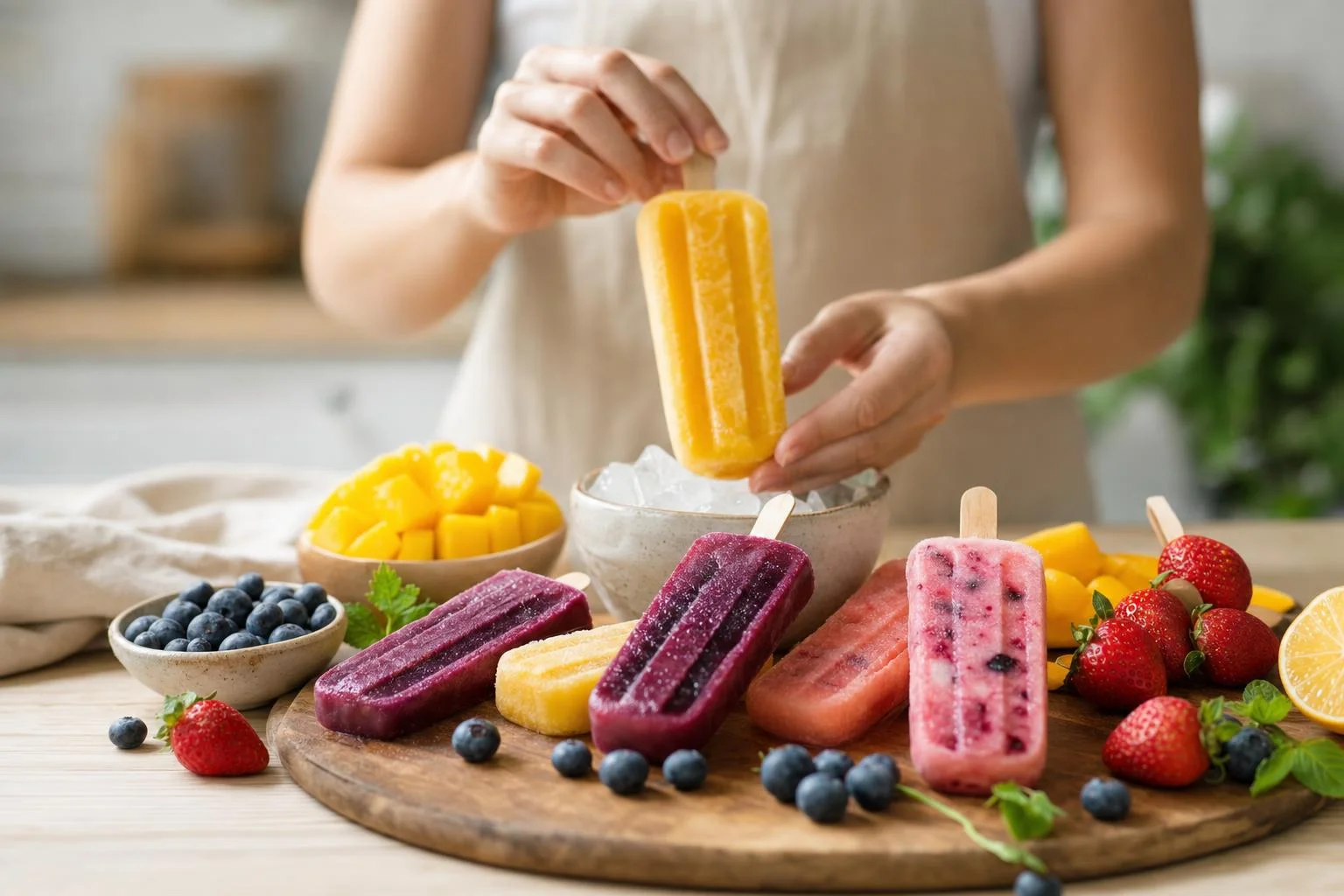
When you bite into an ice pop and taste real raspberry, mango or watermelon — no artificial flavourings, no sugary coating, no chemical aftertaste lingering on the palate — you know this isn't the usual thing. Hand-made ice pops from fresh fruit are getting more popular, and not by chance. At a time when the label on a factory ice cream lists twenty-odd ingredients, half of which you can't even pronounce, more and more people are looking for something simple, natural and genuinely tasty. At Pulpa, the juice bar at the Pazar, Split's Green Market, that's exactly how ice pops are made — from local fruit, with nothing extra, right in front of the customers.
What's actually in a factory-made ice cream?
Before we talk about how a hand-made ice pop comes together, it's worth looking at what exactly goes into the factory kind. A standard fruit-based ice pop from the supermarket rarely contains more than 10 to 15 per cent real fruit juice or fruit pulp. The rest is water, high-fructose corn syrup, dextrose, modified starch, colourings, flavourings and stabilisers such as guar gum, locust bean gum or carrageenan.
Stabilisers and emulsifiers are added to stop large ice crystals from forming, to keep the texture smooth and to stretch the shelf life to months, even a year. There are sound technical reasons for all of that — but it comes at a price. The flavourings that stand in for real fruit are chemically synthesised compounds that imitate the taste, but not the full complexity of the real thing. Everyone knows the result: an intense but one-dimensional flavour that vanishes in a moment.
Then there's the nutritional side. Factory-made ice pops with added sugars and syrups can contain 15 to 20 grams of sugar apiece, while the vitamins and minerals that were originally in the fruit rarely survive industrial processing and high-temperature pasteurisation. Most importantly, children and adults who eat them every day are taking in a fair amount of ultra-processed food with no nutritional benefit at all.
What goes into a hand-made ice pop?
The recipe for a proper hand-made ice pop fits in a few words: fresh fruit, a little liquid and, if needed, a natural sweetener. That's it. In practice, it means taking ripe, seasonal fruit — watermelon, mango, strawberry, passion fruit, orange, peach, lychee — and handling it in a way that keeps everything valuable in it.
At Pulpa, that means working with local family farms that supply fresh local fruit. When you work with fruit picked a day or two earlier, flavour and goodness are at their peak — there's no need for flavour enhancers or preservatives. Fruit that smells of itself, that has colour and taste of its own, doesn't need chemical help to be delicious.
The liquid base can be coconut water, freshly squeezed citrus juice, plant milk or simply water. If the fruit is ripe and sweet enough — like mango or watermelon in the middle of summer — no extra sweetener is needed at all. When it is, natural options such as honey, agave syrup or dates do the job: along with sweetness they bring their own flavour, and they don't cause the sharp spike in blood sugar that comes with refined sugar.
Step by step: how a hand-made ice pop is made
Making a hand-made ice pop is far simpler than it looks — and that simplicity is its strength. No long ingredient lists, no industrial machinery, no factory line. Here's how it works in practice, step by step.
It all starts with choosing and preparing the fruit. The fruit is washed thoroughly, peeled and cut into pieces. At this stage the key is to pick fruit at the peak of ripeness — underripe fruit will be sour and lack aroma, and overripe fruit can bring in a fermented note. Seasonality is your best ally here: strawberries in May and June, watermelon and peaches from July to September, citrus in winter.
Next comes blending or pressing. Depending on the result you want, the fruit can be blended into a smooth purée (like a smoothie base), cold-pressed for a clear juice, or left with visible pieces of fruit that give the finished pop an interesting texture and look. The liquid base and any sweetener go into this mixture, and everything is stirred or blended well. The mixture is then poured into moulds — in a professional setting these are standard silicone or metal moulds that give the pops their familiar shape.
The pops are frozen at minus 18 to minus 22 degrees Celsius, which is colder than the average home freezer. At such a low temperature the ice crystals form small and evenly, which directly affects the creaminess and texture of the finished product. Once fully frozen — which takes four to eight hours, depending on the thickness of the mould and the mixture — the pops are taken out, sometimes coated in a layer of chocolate or dipped in more fruit, and packed or served straight away.
- Choosing ripe, seasonal, local fruit
- Washing, peeling and cutting, with no chemical treatment
- Blending or cold-pressing, depending on the texture you want
- Adding a natural base and, if needed, a natural sweetener
- Filling the moulds and freezing at -18 to -22 °C
- Unmoulding, then serving or packing with no preservatives
Cold-pressing and its role in ice pops
At Pulpa, the cold-pressing philosophy applies to the ice pops as much as to the juices — and that's no accident. Cold-pressing is a way of extracting juice that uses neither heat nor the centrifugal force that warms up the pulp. Instead, the fruit is slowly pressed mechanically at low temperatures, so the juice comes out without oxidation and without heat breaking down delicate vitamins such as vitamin C and folate.
When that juice or pulp becomes the base of an ice pop, the nutrients preserved during pressing stay preserved in the finished frozen product too. Freezing on its own doesn't destroy vitamins — unlike cooking or pasteurisation. So a hand-made ice pop built on cold-pressed juice can genuinely be a nutritious snack, not just a sweet treat.
There's a difference in taste too, and you notice it straight away. Cold-pressed juice keeps all the aromatic complexity of fresh fruit — that slightly floral, slightly sour, slightly earthy note that makes each fruit what it is. Industry tries to copy it with chemical flavourings, but the result is always a flat, two-dimensional flavour that can't compete with the natural original.
The difference in taste: why the natural pop always wins
The difference in taste between a factory-made and a hand-made ice pop isn't a matter of preference or habit — it's objective, and anyone can tell the moment they try the two side by side. A natural pop has a flavour that unfolds: gentle at first, then the sweetness of the fruit, then the acidity, then a longer note at the end. The factory one gives a single hit of sugar and flavouring that disappears at once.
Texture plays its part too. A natural ice pop has no additives to make it perfectly smooth and uniform. It has tiny flecks of fruit fibre, sometimes visible bits of fruit or seeds. That small lack of 'technical perfection' is actually its advantage — the texture is how you know it's real fruit and not reconstituted concentrate.
Colour is another giveaway. A natural strawberry ice pop will be anything from pale pink to deep red, depending on the variety and ripeness of the fruit. The factory one will almost always be an intense crimson that hardly exists in nature — that's the colour of tartrazine or the red dye E129, not of strawberries. Once you start paying attention to colours, it's hard not to wonder what you're actually eating.
Seasonality as the foundation of quality: what's best when
One of the key principles of making hand-made ice pops is respecting the seasons. Fruit that ripens at its own natural pace and is picked when it's ready has far more sugar, aroma and antioxidants than fruit picked unripe and left to ripen in cold storage or in transit. Seasonality isn't a romantic ideal — it's a practical recipe for better flavour and better nutritional value.
In Dalmatia that means: strawberries and cherries in spring, peaches, apricots and watermelon in summer, figs and pomegranates in late summer and early autumn, citrus and kiwi in winter. Every season brings its own palette of flavours and colours, and that shows directly in the ice pops on offer at local juice bars that work with family farms.
Working with local farmers has one more dimension: freshness. Fruit that hasn't travelled thousands of kilometres in a cold chain, but was picked around Split and reached the market the same day, keeps all of its liveliness. That freshness is something you can't buy or imitate — it has to be built through a relationship with the local community and respect for nature's rhythm.
Why hand-made ice pops are a good choice for children and active adults
Children may be the biggest winners when you switch from factory ice cream to hand-made ice pops. A growing child's body is especially sensitive to additives, colourings and too much refined sugar. An ice pop made from fresh fruit with no added sugar is refreshing, tasty and nutritionally sound all at once — a snack that doesn't send a child's blood sugar spiking or chemically stimulate their appetite.
For active adults — runners, cyclists, swimmers, hikers — a natural ice pop can be a great option for recovery after exercise. The electrolytes from the fruit juice, the natural sugars that quickly replenish glycogen and the antioxidants that help calm inflammation in the muscles make it functional food, not just dessert. The nutritional contribution is modest, of course — but it's a positive one, which is more than can be said for the factory alternatives.
People who watch their sugar intake or their weight, or who are gluten- or lactose-intolerant, also find natural ice pops a rare ready-made product they can enjoy without worrying. No milk, no gluten, no added sugar, no preservatives — the list of what's not in them is an argument in itself.
An ice pop made from real fruit isn't just a healthier version of factory ice cream — it's a completely different experience of taste, texture and pleasure. When you know that what you're eating comes from a local family farm, that it was made today, that there's nothing extra in it — every bite is simply better. At Pulpa, the juice bar at the Pazar, that's exactly how the ice pops are made: from fresh local fruit, with no preservatives and no added sugar, right in front of you. If you're nearby or have a special order in mind, get in touch — we'll be glad to cool you down.
Frequently asked questions
How long do hand-made ice pops with no preservatives keep?
Hand-made ice pops with no preservatives keep in the freezer at -18 °C for up to a week without losing flavour or quality. Unlike the factory kind, they have no extended shelf life — and that is exactly the proof that there are no preservatives or additives in them.
Do natural ice pops contain added sugar?
At Pulpa, no sugar is added — the sweetness comes only from ripe, seasonal fruit. When the fruit is ripe enough, especially in summer, no extra sweetener is needed at all. On rare occasions natural alternatives such as honey are used, but never refined sugar or syrups.
Can children eat fresh-fruit ice pops every day?
Yes. Hand-made ice pops from fresh fruit, with no additives and no added sugar, are a perfectly suitable everyday snack for children, especially on hot summer days. They offer refreshment, natural sweetness and vitamins, without the harmful colourings, flavourings and refined sugars found in factory ice cream.
How is cold-pressed juice different from the concentrate used in factory ice cream?
Juice from concentrate is heated and has its water removed, which costs it aroma and some of its vitamins; water and flavourings are then added back to reconstitute it. Cold-pressed juice never comes into contact with heat — the vitamins, enzymes and natural aromas are fully preserved, which gives it a noticeably better taste and nutritional value.
Interested in our ice pops, or would you like to order a larger quantity for a special occasion? Get in touch with the Pulpa team — we make everything to order, from fresh local fruit.
Contact us