Blog
What cold-pressed juice costs and why: from a kilo of fruit to a glass
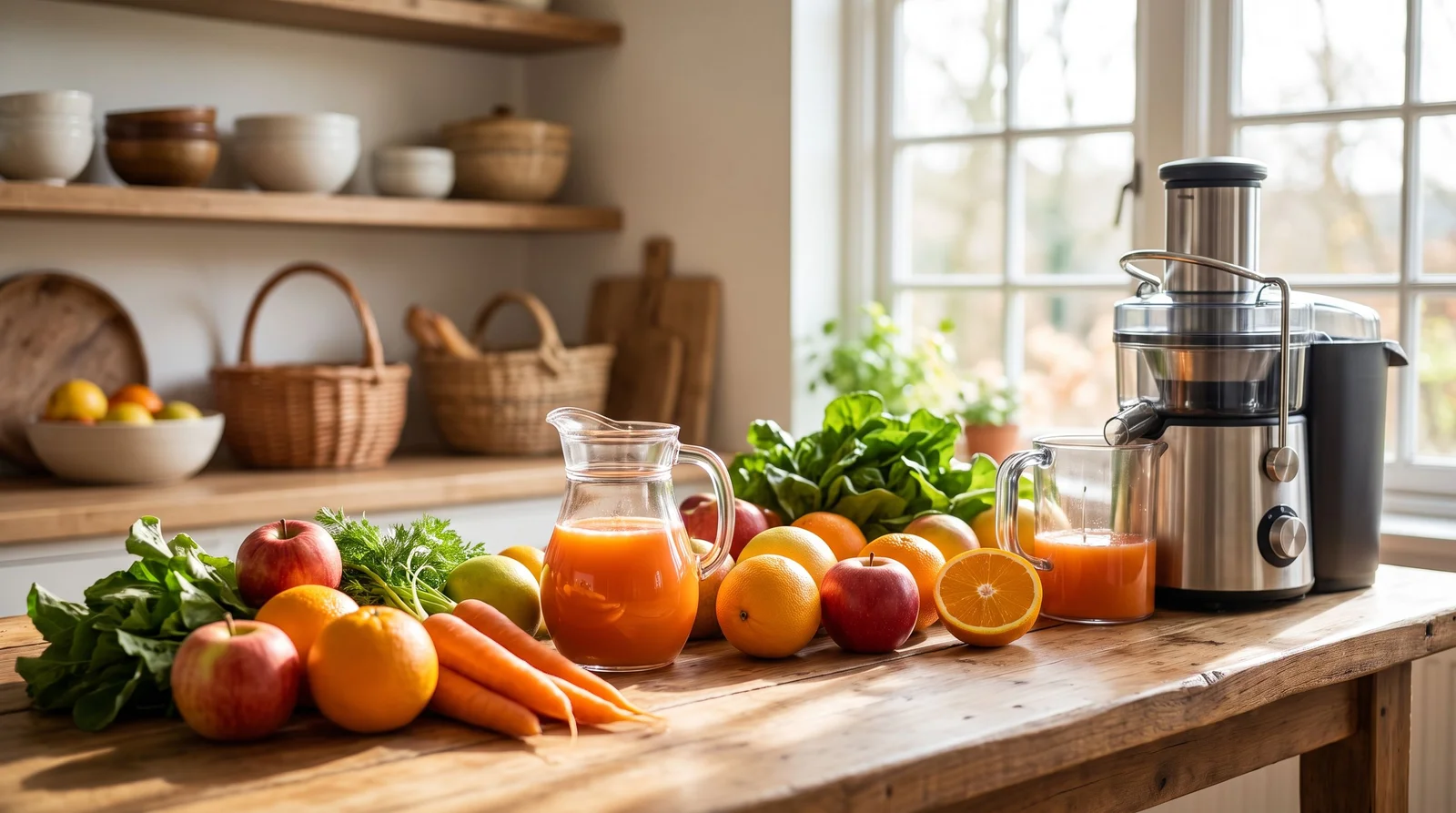
When a guest looks at a cold-pressed juice price list for the first time, the first thought is often: why is this more expensive than the juice in the supermarket fridge? It is a perfectly fair question, and the answer is actually simple once you open up the whole process, from the kilo of fruit it takes to make one glass, to buying from local growers, to the fact that the juice is only made when you order it. In this article we explain, completely openly, everything that goes into the price of a glass of cold-pressed juice and why that price changes from week to week.
How much fruit actually goes into one glass
Cold-pressed juice is not diluted concentrate, and it is not juice with added water and sugar. It is the pure extract of fruit and vegetables, obtained by mechanical pressure without heat. That means the ratio of raw produce to finished juice is much higher than with a regular centrifugal juicer or industrial production.
One glass of orange juice, for example, takes far more oranges than most people would guess, because pressing draws out only the juice, without the pulp that a centrifugal juicer often counts as part of the volume. With green juices made from leafy vegetables like kale or spinach the ratio is even more striking. It takes several handfuls of fresh leaves to get just a few decilitres of juice, because leafy greens are mostly water locked inside cells that do not give it up easily.
Add to that the fact that only ripe, good-quality fruit and vegetables are used, not blemished or damaged produce that would otherwise go to waste, and it is clear that the cost of ingredients per glass is no small item. The quality of the fruit going in shows directly in the taste, colour and nutritional value of the juice, so it is not something to skimp on.
Buying from local family farms, and why it matters more than it looks
Buying fruit and vegetables directly from small family farms is a different thing from buying huge industrial quantities at a low price. Local family farms usually work on a smaller scale, pick by hand and do not always use the intensive farming methods that push up the yield per hectare, so their price per kilo is as a rule higher than what a big distributor of imported fruit would offer.
That price difference is not just a cost. It is also an investment in the local community and in a quality you can taste. Fruit picked at the right moment of ripeness, without a long journey through cold stores and warehouses, has a different make-up of sugars, acids and aromas than fruit picked unripe so it can survive transport. When juice is made from fruit like that, you can see the result in both the colour and the body, and that simply cannot be achieved with cheaper produce.
Working with smaller growers also means less flexibility on quantities. If a farm has a poor watermelon harvest or not enough strawberries that year, that item simply drops off the menu or goes up in price, because it is not replaced with imports at any cost. That is a conscious choice that protects quality, but it also carries a risk that has to be built into the price.
Seasonal swings: why the price of orange juice can vary
Anyone who follows fruit prices at the market knows that the same produce can cost two or even three times as much at different points in the year, depending on the season, the weather and supply. Oranges are cheaper and better in the full winter season, while out of season they are imported, more expensive and often less juicy. Strawberries are at their best and most affordable in May and June, while earlier or later in the season they are scarcer and dearer.
When bad weather such as hail, drought or too much rain cuts the harvest, the price growers charge jumps almost overnight, and that cost has to be passed on somehow, because the margin on fresh produce is never large. That is exactly why the cold-pressed juice menu naturally follows the season. Not as a marketing trick, but because working with seasonal, local fruit means accepting that price and availability are not the same all year round.
This variation is actually a sign that the product is genuine. A place that offers the same strawberry juice at the same price in January and in June is probably not using fresh seasonal fruit, but a frozen or imported substitute that is available all year.
Made to order: why there is no stock in the fridge
One of the basic differences between a cold-pressed juice made in front of the guest and an industrial juice from the shelf is when it is made. Industrial juices, even those labelled cold-pressed, often go through high-pressure pasteurisation (HPP) to stretch their shelf life to several weeks, which allows mass production, distribution and storage in large quantities.
When juice is pressed only after it is ordered, there are no economies of scale. Every glass means washing, cutting and preparing the fruit separately, pressing it separately, and cleaning the press before the next order if the type of juice changes. It is a slower process that takes more working time per glass, and working time is one of the biggest costs in a business like this.
The advantage, of course, is in the taste and the nutrition. Vitamins that are sensitive to heat and oxidation, like vitamin C, start to break down as soon as the fruit is cut and pressed. The fresher the juice when you drink it, the more of those nutrients are still there. That difference in quality has its price, because faster, mass production simply cannot offer the same.
A short shelf life, and the waste that has to be counted in
Juice with no preservatives and no heat treatment naturally has a short shelf life, usually just one to three days if properly chilled, compared with the weeks or months that pasteurised or preserved juices last. That means you cannot make big batches in advance, and you cannot order produce a week ahead without the risk that some of it spoils before it is used.
A short shelf life also carries a business risk. If we misjudge how many guests will come, the extra prepared fruit or finished juice simply spoils and has to be thrown away, and that loss, whether we like it or not, has to be covered somehow through the price of what does sell. Industrial producers remove that risk precisely through pasteurisation and preservatives, which lets them charge less, but at the expense of freshness and ingredients.
So working on the principle of 'we make it when you order it' means less waste, in the sense that no juice is made that nobody will drink. But it also means produce has to be bought often, in smaller, fresher amounts, which is more demanding and more expensive logistically than the big weekly or monthly deliveries of industrial production.
What you are really paying for when you order a glass of cold-pressed juice
When you add it all up, the price of a glass of cold-pressed juice is made up of a few clear items: the amount of good fruit and vegetables needed for one glass, the price paid to local growers, which is usually higher than industrial sourcing, the seasonal swings in produce prices, the labour of preparing every order by hand, one at a time, and the risk and loss that come with the short shelf life of a fresh product with no preservatives.
That is why comparing it with industrial juice from the supermarket fridge is not quite comparing like with like. They are two different products, with a different process, different ingredients and a different purpose. Industrial juice offers convenience, a long shelf life and a lower price per unit. Cold-pressed juice made on the spot offers freshness, more nutrients and complete transparency about what is actually in the glass.
Understanding these factors helps a guest make an informed choice, and to see the price as a reflection of real work and real produce, not an arbitrary number on a menu.
The price of cold-pressed juice is the story of every step before the glass reaches your hand: choosing ripe fruit from a local family farm, pressing it by hand without rushing, and a short shelf life that guarantees freshness but rules out stock. Once you understand those factors, the price stops being a question and becomes a clear reflection of the effort and quality behind it. If you want to know what is on the counter today or have a question about the menu, come and see us at the Pazar, Split's Green Market, or get in touch by phone or message. We will happily explain everything in person, with a glass of freshly pressed juice in your hand.
Frequently asked questions
Why is cold-pressed juice more expensive than a carton from the shop?
Because it contains far more fresh fruit per glass, is made without preservatives or added sugar, is only prepared when you order it, and uses produce bought from small local growers at a higher price than mass industrial sourcing.
Why does the price of the same juice vary during the year?
Because it is made with seasonal fruit and vegetables, whose price and availability depend on the harvest, the weather and the time of picking. Out of season, some fruit is scarcer and more expensive, and that shows in the menu.
How much fruit does one glass of juice actually take?
It depends on the fruit, but as a rule far more than you would expect, especially with leafy vegetables like kale or spinach, where it takes several handfuls to get just a couple of decilitres of juice.
Why does the juice menu change from day to day?
Because we work only with fresh, seasonal fruit that is available from growers at that moment, with no big stock, so the menu naturally follows what is available and good that week.
Drop by our stand at the Pazar and try a juice pressed just for you. We will tell you what is fresh on the counter that day.
Contact us